CMSA Biography
Biography - Dr. Wesley N. Colley
Dr. Wesley N. Colley
Senior Research Scientist

colleywReplace this symbol with "@" when composing an email to this person.  This method is used to combat automated email collection.uah.edu
(256) 824-4625 Phone
(256) 824-4322 Fax

301 Sparkman Drive
VBRH D-15
Huntsville, AL 35899


Dr. Wesley N. Colley
Dr. Colley received his Ph.D. in astrophysical sciences from Princeton University in 1998. During his graduate work, Dr. Colley focused on gravitational lensing and cosmology. His team at Princeton monitored the brightness fluctuations of particular lensed-quasar system that allowed them to settle a decades-old controversy over the implied value of the Hubble Constant, which sets the size scale for the Universe. He used Hubble Space Telescope imaging of a gravitationally lensed-cluster system, to measure the mass of the very distant cluster of galaxies, and exploit the lens's magnification to realize Einstein’s dream of a “gravitational telescope” in which the gravity of a foreground celestial body forms enhances our view of very distant background objects.

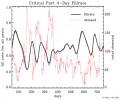
Dr. Colley spent 1998–2000 as a post-doctoral fellow at the Harvard-Smithsonian Center for Astrophysics. He continued his work in gravitational lensing, focusing on very rapid brightness fluctuations in a quasar lens system that would indicate the presence of planetary mass dark matter in the lens galaxy. Detection of such fluctuations, however, required dedicated monitoring around the clock during two campaigns of 10 days each. Colley and a colleague, therefore, formed a collaboration of 13 observatories around the world, including sites in Korea, Ukraine, Israel, Spain, Mexico, Canada and Arizona. Colley developed a highly automated software system to process the thousands of images collected, and achieved 1% precision in the quasar brightness measurements with continuous hourly sampling. The effort produced the first-ever sub-day time-delay for a lens system. The resulting refinement allowed Colley to discover a very rapid fluctuation in a previous dataset that suggests the presence of an earth-mass object in the lens galaxy (which is halfway across the Universe); this is possibly a detection of an extra-galactic planet.

Dr. Colley then moved to the Space Control Group of M.I.T.'s Lincoln Laboratory as a technical research staff member. His research focused on the Space-Based Infrared System (SBIRS). This system would field a constellation of low-earth orbit mid-infrared satellites that would observe a missile from the end of the boost phase throughout the mid-course, including deployment of re-entry vehicles and decoys. The system would determine orbits for each object (r.v. or decoy) for hand-off to ground-based radar and interceptors. Dr. Colley's work focused on inter-platform object identification to build a unified target object map, for handoff to ground radar and interceptor systems.

Dr. Colley returned to astrophysics as a lecturer at the University of Virginia, where he continued his work on gravitational lensing by developing models to help understand the rapid brightness fluctuations mentioned above, and by developing dramatically faster simulations of gravitational lensing that could test these models against observation. He also quantified the shapes of large-scale structures seen in the cosmic microwave background as seen by the Wilkinson Microwave Anisotropy Probe (showing consistency with the Inflationary prediction of Gaussian random-phase quantum fluctuations).

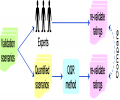
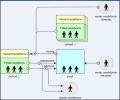
Colley first became involved in formal modeling and simulation (M&S) at the Virginia Modeling, Analysis and Simulation Center (VMASC) at Old Dominion University. There he worked under Homeland Security funding to model mass casualty events in urban environments. A massively parallel agent architecture was used to estimate the load on medical infrastructure during the aftermath of such an event. In separate work, he helped develop a formal validation methodology for large operational training simulations under Naval Commander Operational Test and Evaluation Force (ComOpTEvFor). Colley traveled to Camp Smith in Hawaii, and Eglin Air Force Base with students to test the method in support of the Terminal Fury ’05 exercise.

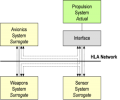
The Center for Modeling, Simulation and Analysis at the University of Alabama in Huntsville came on line in 2005. Colley joined the new team and began work immediately with NASA to enhance Marshall Space Flight Center’s M&S capabilities in support of systems engineering for the upcoming lunar missions. Colley is currently working with students to federate current stand-alone tools at MSFC into a large distributed simulation that includes high-fidelity propulsion, aerodynamics, electrical and structural models, as well as high-end visualization tools and virtual environments. Under the Army’s Aviation and Missile Command, Colley has used discrete event simulation techniques to develop custom software that will help optimize inventory stocking strategies for aviation parts in Southeast Asia. He will shortly begin work with the Naval Air Warfare Center on validation methodologies for Netcentric Warfare Test and Evaluation tools.

Publications in Refereed Journals
  • Colley, W.N., 2004, "Comments on College Football Computer Rankings," American Statistician, 58: #3, 191–192

  • Colley, W.N. & Schild, R.E., 2003, "A Rapid Microlensing Event in the Q0957+561 A, B Gravitational Lens System," Astrophysical Journal, 594: 97–100

  • Colley, W.N. & Gott, J.R., 2003, "Genus Topology of the Cosmic Microwave Background from WMAP," Monthly Notices of the Royal Astronomical Society, 384: 686–695

  • Colley, W.N., Shapiro, I.I, Pegg, J., Turner, E.L, Kundic, T., Loomis, K., Hastings, N. C. & McMillan, R., 2003, "Rapid Brightness Fluctuations in Q0957+561A, B: Microlensing or Seeing?," Astrophysical Journal, 588: 711–715

  • Colley, W.N., Schild, R.E., Abajas, C., Alcalde, D., Aslan, Z., Bikmaev, I., Chavushyan, V., Chinarro, L., Cournoyer, J., Crowe, R., Dudinov, V., Kathinka, A., Evans, D, Jeon, Y., Goicoechea, L.J., Golbasi, O., Khamitov, I., Kjernsmo, K., Lee, H.J., Lee, J., Lee, K.W., Lee, M.G., Lopez-Cruz, O., Mediavilla, E., Moffatt, A.F.J., Mujica, R., Ullan, A.M., Oscoz, A., Park, M., Purves, M., Sakhibullin, N., Sinelnikov, I., Stabell, R., Stockton, A., Teuber, J., Thompson, R., Woo, H. & Zheleznyak, A., 2003, "Around the Clock Observations of the Q0957+561 A, B Gravitationally Lensed Quasar II: Results for the second observing season," Astrophysical Journal, 587: 71–79

  • Schmidt, R.W., Kundic, T., Pen, U., Turner, E.L. Wambsganss, J., Bergeron, E., Colley, W.N., Corson, C., Hastings, N.C., Hoyes, T., Long, D.C., Loomis, A., Malhotra, S., Rhoads, J.E., & Stanek, K.Z., 2002, "Optical Monitoringof the Gravitationally Lensed Quasar Q22367+0305 from APO between June 1995 and January 1998," Astronomy and Astrophysics, 392: 773–779

  • Colley, W. N., Schild, R. E., et al., 2002, "'Round the Clock Observations of the Q0957+561 A, B Gravitationally Lensed Quasar," Astrophysical Journal, 565: 105–107

  • Wambsganss, J.W., Schmidt, R.W., Colley, W.N., Kundic, T. & Turner, E.L., 2000, "Microlensing Results from APOMonitoring of Quasar Q0957+561A, B between 1995 and 1998," Astronomy and Astrophysics, 362: L37–L40

  • Colley, W.N. & Schild, R.E., 2000, "Hourly Variability in Q0957+561," Astrophysical Journal, 540: 104–112

  • Colley, W.N., Gott, J.R., Weinberg, D., Park, C. & Berlind, A., 1999, "Genus Topology from the Simulated Sloan Digital Sky Survey," Astrophysical Journal, 529: 795–801

  • Colley, W. N. & Schild, R. E., 1999, "Precision Photometry of Q0957+561," Astrophysical Journal, 518: 153–164

  • Park, C., Colley, W.N., Gott, J.R., Ratra, B., Spergel, D.N. & Sugiyama, N., 1998, "Topology and Correlation Function in Simulated CMB Anisotropies from MAP for CDM Cosmogonies," Astrophysical Journal, 506: 473–484

  • Colley, W. N., 1997, "Two Dimensional Topology of Large Scale Structure in the Las Campanas Redshift Survey," Astrophysical Journal, 489: 471–475

  • Colley, W. N., Gnedin, O. Y., Ostriker, J. P. & Rhoads, J. E., 1997, "Dynamics of `Small Galaxies' in the Hubble Deep Field," Astrophysical Journal, 488: 579–584

  • Kundic, T., Colley, W. N., Gott, J. R., Malhotra, S., Pen, U., Rhoads, J. E., Stanek, K. Z., Turner, E. L., Wambsganss, J., Bergeron, E., Gloria, K. & Long, D., 1997, "A Robust Determination of the Time Delay in 0957+561A, B and a Measurement of the Global Value of Hubble's Constant," Astrophysical Journal, 482: 75–82

  • Colley, W. N., Rhoads, J. E., Spergel, D. N. & Ostriker, J. P., 1996, "Are the Hubble Deep Field Galaxy Counts Whole Numbers?," Astrophysical Journal Letters, 473: 63–66

  • Colley, W. N., Gott, J. R. & Park, C. B., 1996, "Topology of COBE Microwave Background Fluctuations," Monthly Notices of the Royal Astronomical Society, 281: L82–L84

  • Colley, W. N. & Sparke, L. S., 1996, "Evolution of Viscous Inclined Disks in Axisymmetric and Triaxial Galaxies," Astrophysical Journal, 471: 748–761

  • Colley, W. N., Tyson, J. A. & Turner, E. L., 1996, "Unlensing Multiple Arcs in 0024+16: Reconstruction of the Source Image," Astrophysical Journal Letters, 461: L83–L86

  • Kundic, T., Colley, W. N., Gott, J. R., Malhotra, S., Pen, U., Rhoads, J. E., Stanek, K. Z., Turner, E. L. & Wambsganss, J., 1995, "An Event in the Light Curve of 0957+561A and Prediction of the 1996 Image B Light Curve," Astrophysical Journal Letters, 455: L5–L8

  • Colley, W. N. & Gott, J. R., 1995, "Naked Eye Observable Microlensing Events," Astrophysical Journal, 452: 82–87

  • O'Connell, R. W., Gallagher, J. S., Hunter, D. A. & Colley, W. N., 1995, "Hubble Space Telescope Imaging of Super Star Clusters in M82," Astrophysical Journal Letters, 446: L1–L4

  • Colley, W. N., 1995, "Observational Prospects for Extragalactic Microlensing Events," Astronomical Journal, 109: 440–444

Presentations--Professional
  • "Techniques for Target Association in the SBIRS Context," Space Control Group, M.I.T. Lincoln Laboratory, December 2001

  • "Gravitational Lensing with Hubble Space Telescope," M.I.T. Lincoln Laboratory, October 2000

  • "Preliminary Results from QuOC Around the Clock," Optical and Infrared Division, Harvard-Smithsonian Center for Astrophysics, May 2000

  • "Gravitational Lenses for Cosmology Statistics," Agnes Scott College, February 2000

  • "Hourly Brightness Fluctuations in Q0957+561," Gravitational Lensing: Recent Progress and Future Goals, Boston University, July 1999

  • "New Methods in Photometry for Q0957+561," Optical and Infrared Division, Harvard-Smithsonian Center for Astrophysics, September 1998

  • "Dynamics of Small Galaxies in the Hubble Deep Field," Theory Division, Harvard-Smithsonian Center for Astrophysics, November 1997

  • "Statistics from New Datasets in Cosmology," Department of Astrophysical Sciences, Princeton University, May 1997

  • "Cosmological Parameters from Gravitational Lenses," Goddard Space Flight Center, February 1997

Presentations--Popular
  • "Gravitational Lenses as Cosmological Laboratories," Christa McAulliffe Planetarium, Concord, NH, February 1999

  • "Cosmology from Gravitational Lenses," Hayden Planetarium, New York, NY, November, 1997

  • "Strong Gravitational Lensing," Union County Amateur Astronomers, NJ, October, 1996

  • "Possible Dynamical Scenarios of Faint Objects in the Hubble Deep Field